- Home
- article
- The Indian Constitution: A Collective Masterpiece Beyond the Single-Man Narrative - Remembering the Many Constitutionalists Who Gave Us the Republic
The Indian Constitution: A Collective Masterpiece Beyond the Single-Man Narrative - Remembering the Many Constitutionalists Who Gave Us the Republic
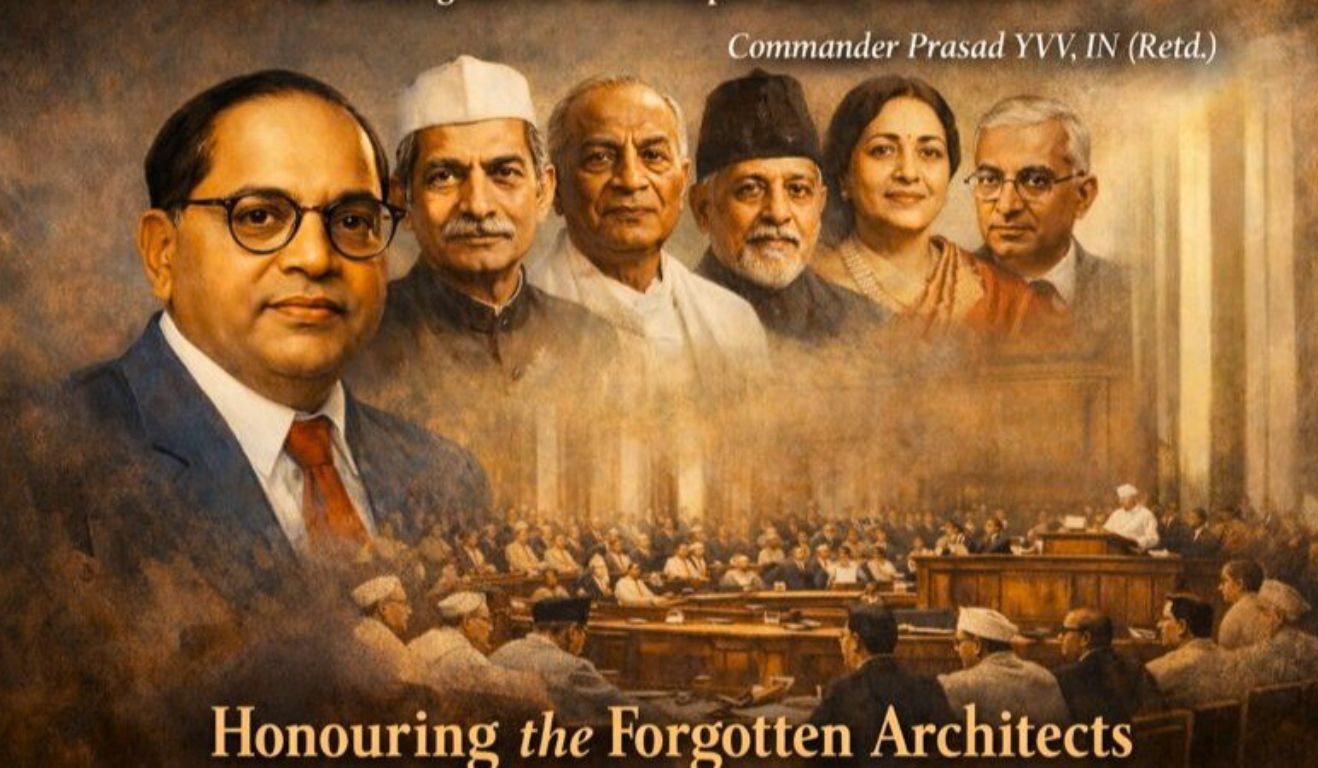
Abstract
The Constitution of India is widely admired as one of the most comprehensive and enduring constitutional documents of the modern world. Yet, in popular memory and public discourse, its making is often attributed almost exclusively to a single towering figure. While the leadership, intellect, and moral authority of Dr. B. R. Ambedkar as Chairman of the Drafting Committee are beyond dispute, the Constitution itself was not the creation of one mind, one pen, or one moment in history.
This article seeks to restore balance to our constitutional remembrance. It presents the Indian Constitution as a collective intellectual, moral, and institutional achievement, shaped by a large and diverse body of jurists, administrators, statesmen, women leaders, social reformers, and representatives of India’s provinces, communities, and princely states. Working through the Constituent Assembly and its many committees over nearly three years of rigorous deliberation, these constitutionalists debated principles, refined language, resolved disagreements, and forged consensus.
The purpose of this reflection is not to diminish any individual’s contribution, but to honour all those who laboured—often anonymously—for the Republic. By remembering the many hands and minds behind the Constitution, we pay a more truthful and complete homage to the democratic spirit that gave birth to India’s Republic.
Prologue – Why This Reflection, Why Now
Every Republic carries within it a duty of remembrance. On each Republic Day, we celebrate the adoption of the Constitution as the foundational act of India’s sovereign life. Yet remembrance, when simplified too far, risks becoming incomplete. Over time, complex collective processes are often reduced to single names, and institutional achievements are remembered through individual symbols.
The making of the Indian Constitution was neither a solitary endeavour nor an act of sudden inspiration. It was the outcome of sustained intellectual effort, patient debate, and principled disagreement among hundreds of members of the Constituent Assembly. Lawyers argued fine points of law, administrators cautioned about governance realities, social reformers pressed moral claims, and representatives of regions and communities negotiated their place within a united India.
This reflection is offered in that spirit. It does not question reverence; it deepens it. It does not replace one narrative with another; it completes the narrative. By recalling the many constitutionalists who contributed to this monumental work, we reaffirm a fundamental truth of democracy itself: that enduring institutions are built not by one voice alone, but by many, working together in reasoned freedom.
“Democracy matures not when it venerates one voice alone, but when it remembers all who laboured to give it form.”
II. The Constituent Assembly – The True Author of the Constitution
The Indian Constitution must be understood first and foremost as the work of the Constituent Assembly itself. It was this body not any individual that functioned as the principal author, debating chamber, and moral custodian of the constitutional text. The Assembly was conceived as a representative forum of India’s vast diversity, entrusted with the historic responsibility of giving a constitutional form to a newly independent nation.
Composition and Diversity of the Assembly
The Constituent Assembly brought together a remarkable spectrum of Indian society. Its members included eminent jurists, seasoned administrators, freedom fighters, economists, educationists, social reformers, women leaders, representatives of labour and agrarian interests, minorities, and delegates from both British Indian provinces and princely states. This diversity was not incidental; it was foundational. The Constitution was shaped by voices drawn from different regions, languages, social realities, and ideological traditions, ensuring that no single worldview could dominate unchecked.
Duration, Sittings, and Seriousness of Deliberations
The Assembly functioned over a prolonged and demanding period, from December 1946 to November 1949. During this time, it held 165 sittings devoted exclusively to constitutional business. These sessions were neither ceremonial nor perfunctory. Each article was examined with seriousness, often debated line by line, and subjected to scrutiny from multiple perspectives. Members spoke not merely as politicians, but as trustees of a future Republic whose decisions would bind generations yet unborn.
A Constitution Forged Through Debate and Consensus
Far from being a predetermined document, the Constitution emerged through rigorous debate, frequent amendment, and conscious compromise. Proposals were contested, revised, accepted, or rejected after reasoned discussion. Disagreements were recorded openly, dissenting opinions were expressed without fear, and consensus was built patiently rather than imposed. The final text thus represents not unanimity of opinion, but unity of purpose—a shared commitment to democratic governance, justice, and constitutional morality.
The authority of the Indian Constitution flows precisely from this process. It is authoritative not because it bears the imprint of a single mind, but because it embodies the considered judgment of a representative Assembly acting in the full light of democratic deliberation.
“Democracy is government by discussion.”
III. Architecture of Constitution-Making – Committees, Not Individuals
The making of the Indian Constitution was consciously designed as an institutional process rather than an individual endeavour. The leaders of the Constituent Assembly understood that a document meant to govern a vast, diverse, and democratic nation could not be entrusted to a single authority or intellect. Instead, constitution-making was organised through a carefully structured system of committees, each entrusted with a defined mandate and area of responsibility.
Why Committees Were Necessary
The complexity of India’s social fabric, federal structure, and democratic aspirations demanded specialised attention. Questions of fundamental rights, Centre–State relations, minority protections, legislative powers, and procedural rules required deep expertise, sustained discussion, and cross-verification. Committees allowed the Assembly to distribute this intellectual labour, draw upon subject-specific competence, and prevent the concentration of constitutional authority in any one individual or group.
Major Committees and Their Mandates
Several key committees formed the backbone of the constitution-making process. The Union Constitution Committee examined the structure and powers of the central government. The Provincial Constitution Committee addressed the distribution of powers between the Union and the provinces. The Advisory Committee dealt with fundamental rights, minority safeguards, and tribal areas. The Drafting Committee was tasked with translating the Assembly’s decisions into precise legal language. Other committees focused on rules of procedure, finance, and the overall coordination of Assembly business. Together, these bodies ensured that every constitutional question was examined from multiple angles before reaching the floor of the Assembly.
Separation of Philosophy, Policy, Drafting, and Procedure
A defining strength of the Indian constitutional process was the clear separation between philosophical vision, policy determination, legal drafting, and procedural management. Broad principles were debated and settled in the Assembly and its advisory bodies. Policy choices were shaped through political discussion and consensus. Legal form and coherence were entrusted to expert drafters. Procedural discipline ensured order, continuity, and fairness in deliberations. This separation safeguarded the Constitution from impulsive decision-making and reinforced its character as a reasoned and institutional creation.
The result was a Constitution that reflected collective wisdom rather than personal authority an architecture of governance built through institutions, not individuals.
“Institutions are the means through which the wisdom of many outlives the will of one.”
IV. The Drafting Committee – Leadership with Collective Responsibility
The Drafting Committee occupied a pivotal but carefully circumscribed position in the making of the Indian Constitution. Its authority lay not in determining constitutional philosophy or policy, but in giving precise legal form to decisions already debated and settled by the Constituent Assembly and its various committees. Understanding this distinction is essential to appreciating both the importance and the limits of the Drafting Committee’s role.
Mandate of the Drafting Committee
The Drafting Committee was entrusted with the task of preparing the constitutional text in clear, coherent, and enforceable legal language. It examined resolutions passed by the Assembly, reconciled overlapping provisions, removed inconsistencies, and ensured internal harmony across articles. Where ambiguities arose, the Committee proposed formulations for the Assembly’s consideration, but it did not function as a sovereign policy-making body. Its mandate was technical, juristic, and integrative rather than ideological.
Chairmanship and the Role of Coordination
The Committee functioned under the chairmanship of Dr. B. R. Ambedkar, whose intellectual depth, legal acumen, and moral authority provided essential leadership. As Chairman, his role was one of coordination and synthesis—guiding discussions, presenting draft provisions to the Assembly, and explaining their legal implications. He acted as the principal spokesman for the Committee, responding to critiques, proposing revisions, and facilitating consensus, while remaining accountable to the collective judgment of the Assembly.
Policy Decisions and Legal Drafting: A Clear Distinction
A defining feature of the Indian constitutional process was the strict separation between policy determination and legal drafting. Fundamental choices regarding rights, governance, federalism, and social justice were made through political debate and Assembly resolutions. The Drafting Committee translated these choices into constitutional language, ensuring clarity, precision, and durability. This division of labour preserved democratic legitimacy while securing technical excellence.
The Drafting Committee thus exemplified leadership without absolutism authority exercised within institutional limits, and expertise deployed in service of collective decision-making rather than individual will.
“True leadership in a democracy refines the will of the many; it does not replace it.”
V. The First Draft and the Constitutional Adviser
Behind the visible debates of the Constituent Assembly lay a body of quiet, exacting, and indispensable intellectual labour. Central to this foundational work was the office of the Constitutional Adviser, whose role was to provide research, comparative insight, and preliminary structure to the emerging Constitution. This contribution, though largely invisible to public memory, formed the bedrock upon which subsequent deliberations and drafting were built.
Role of the Constitutional Adviser
The Constitutional Adviser functioned as the Assembly’s principal scholarly and technical resource during the early stages of constitution-making. The Adviser assisted the Assembly by collating resolutions, clarifying constitutional concepts, identifying precedents, and presenting legally coherent options for consideration. This role required neutrality, depth of legal understanding, and an ability to translate political intent into workable constitutional form without supplanting the Assembly’s authority.
Comparative Constitutional Research
A defining feature of this advisory work was extensive comparative research. Constitutional practices and texts from established democracies including those of the United Kingdom, the United States, Canada, Ireland, and Australia were carefully studied. The objective was not imitation, but informed adaptation. Comparative analysis helped identify tested mechanisms of governance, rights protection, and federal balance, while also revealing limitations that India needed to avoid in light of its unique social and historical context.
Preparation of the First Consolidated Draft
Drawing upon Assembly resolutions and comparative study, the Constitutional Adviser prepared the first consolidated draft of the Constitution. This draft provided a structured starting point for clause-by-clause examination by committees and the full Assembly. It did not claim finality; rather, it served as an intellectual scaffold one that invited critique, amendment, and refinement. Much of the later drafting effort involved reshaping, expanding, and revising this initial framework in response to Assembly debates.
This early, unseen labour ensured that the Constitution did not emerge from improvisation, but from preparation. It reminds us that enduring constitutional structures often rest upon foundations laid in silence, long before they are tested in the open forum of democratic debate.
“What is unseen often sustains what endures.”
VI. Roll of Honour – The Constitutionalists of India
This section stands as a tribute to the many constitutionalists whose collective intellect, experience, and moral commitment shaped the Indian Constitution. The names that follow are grouped by the nature of their contribution, not by rank, fame, or hierarchy. Each played a distinct role in a shared constitutional enterprise. Together, they represent the plural mind of the Republic.
VI(A). Jurists and Legal Architects
Dr. B. R. Ambedkar – Jurist, social thinker, and Chairman of the Drafting Committee. He provided juristic leadership, coordinated the drafting process, and articulated constitutional provisions before the Assembly with clarity and rigour, while remaining accountable to its collective will.
Alladi Krishnaswami Ayyar – A distinguished jurist whose deep understanding of constitutional law shaped provisions relating to fundamental rights, judicial review, and constitutional remedies. His interventions reflected a balance between legal precision and democratic principle.
K. M. Munshi – Lawyer, thinker, and member of the Drafting Committee. He contributed significantly to the articulation of fundamental rights and civil liberties, and to debates on cultural and social questions within the constitutional framework.
Syed Mohammad Saadullah – Jurist and statesman who brought administrative and legal experience to constitutional discussions, particularly on federal arrangements and minority concerns.
VI(B). Statesmen and Political Thinkers
Jawaharlal Nehru – Prime Minister-designate and a leading voice of the Assembly. Through the Objectives Resolution, he articulated the philosophical vision of the Constitution, embedding ideals of sovereignty, democracy, secularism, and social justice.
Rajendra Prasad – President of the Constituent Assembly. He guided proceedings with restraint and fairness, ensuring orderly debate, institutional discipline, and respect for divergent viewpoints.
Sardar Vallabhbhai Patel – Chairman of key committees on federal structure and integration. His role was crucial in shaping Centre–State relations and integrating princely states into the constitutional framework.
VI(C). Administrators and Federal Thinkers
N. Gopalaswami Ayyangar – Administrator and constitutional thinker who contributed to the design of Centre–State relations, emergency provisions, and administrative coherence in a complex federation.
B. N. Rau – Constitutional Adviser to the Assembly. He prepared the first consolidated draft of the Constitution and provided comparative constitutional insights drawn from multiple democratic systems.
T. T. Krishnamachari – Economist and administrator who contributed to financial provisions, economic governance, and pragmatic assessments of constitutional feasibility.
VI(D). Voices of Social Justice, Labour, and Agrarian India
Jagjivan Ram – Freedom fighter and social reformer who articulated concerns of social equality, labour welfare, and the dignity of marginalised communities within constitutional discourse.
N. G. Ranga – Peasant leader and economist who represented agrarian interests, land reforms, and rural realities, ensuring that the Constitution addressed the concerns of India’s vast rural population.
B. Shiva Rao – Constitutional scholar and administrator whose documentation and analytical work preserved the intellectual history of the Assembly’s debates.
VI(E). Women Constitutionalists
Hansa Mehta – Educationist and social reformer who advocated gender equality and played a key role in shaping provisions on fundamental rights and equal citizenship.
Dakshayani Velayudhan – Social worker and the only Dalit woman in the Assembly. She spoke forcefully for human dignity, social equality, and the moral responsibilities of constitutional democracy.
Rajkumari Amrit Kaur – Freedom fighter and public leader who contributed perspectives on social welfare, health, and the role of the State in ensuring human well-being.
VI(F). Minority, Cultural, and Ethical Voices
Maulana Abul Kalam Azad – Scholar and statesman who articulated a vision of cultural pluralism, secularism, and inclusive nationalism within the constitutional framework.
Frank Anthony – Educationist and representative voice for minority rights, contributing to constitutional safeguards for cultural and educational autonomy.
VI(G). Representatives of Princely States and Regional Interests
K. T. Shah – Economist and constitutional thinker who advanced proposals on rights, economic justice, and federal principles, often stimulating rigorous debate within the Assembly.
H. V. Kamath – Parliamentarian and intellectual who contributed to discussions on civil liberties, democratic safeguards, and ethical governance.
These names, among many others, remind us that the Indian Constitution is the outcome of shared labour and shared responsibility. Its authority flows from the diversity of minds that shaped it and the seriousness with which they approached their historic task.
“Gratitude in a Republic is owed not to one voice alone, but to all who laboured in its making.”
VII. Debate, Dissent, and Consensus – How the Constitution Was Forged
The authority and resilience of the Indian Constitution arise not from unanimity, but from disciplined disagreement. The Constituent Assembly treated debate as a constitutional virtue, recognising that durable principles are refined through contestation rather than imposed through silence. Disagreement was not viewed as disloyalty to the national project, but as a necessary instrument for arriving at balanced outcomes.
Recorded Disagreements and Amendments
Assembly proceedings reveal a culture of rigorous engagement. Members proposed amendments, questioned assumptions, and challenged draft provisions in open session. These disagreements were formally recorded, responded to, and where persuasive incorporated into revised text. The amendment process was not ornamental; it was central to the evolution of many articles, ensuring clarity, feasibility, and fairness.
Rejections and Compromises
Equally significant were proposals that did not find acceptance. Some ideas were rejected after debate on grounds of practicality, constitutional coherence, or long-term consequences. Others were modified through compromise, blending competing concerns into workable formulations. These outcomes demonstrate a willingness to subordinate individual preference to collective judgment an essential discipline of constitution-making.
Maturity of Constitutional Culture
The Assembly’s work reflected a mature constitutional culture marked by patience, restraint, and respect for procedure. Strong views were expressed without coercion; minority opinions were heard without fear. The final text bears the imprint of this culture: principled yet pragmatic, idealistic yet implementable. It is this process open, reasoned, and accountable—that confers legitimacy on the Constitution and sustains its authority over time.
“Dissent is not the negation of democracy; it is the means by which democracy strengthens itself.”
VIII. How Public Memory Became Singular
Public memory rarely preserves complexity. Over time, collective achievements are often distilled into symbols that are easier to communicate, commemorate, and mobilise. The history of the Indian Constitution is no exception. The gradual narrowing of constitutional memory to a single, highly visible figure did not occur through deliberate exclusion, but through processes of symbolism, pedagogy, and simplification.
Symbolism and Political Pedagogy
In a vast and diverse democracy, symbols play an essential role in civic education. Faces, statues, anniversaries, and simplified narratives help transmit constitutional values to large populations. Political pedagogy—especially in the early decades of the Republic—naturally gravitated toward emblematic leadership figures who could embody constitutional ideals in a single, recognisable form. This symbolic condensation aided mass understanding, even as it reduced institutional complexity.
Simplification of Constitutional History
Constitutional history, with its committees, drafts, debates, and amendments, is inherently intricate. For textbooks, public discourse, and popular narratives, such intricacy is often streamlined into linear stories with clear protagonists. In this process, collective authorship gives way to individual attribution. Simplification, while pedagogically useful, can unintentionally obscure the collaborative nature of constitution-making.
Visual Memory Versus Archival Truth
Public memory is shaped as much by what is seen as by what is recorded. Statues, portraits, commemorative spaces, and public rituals reinforce visual memory, while archival materials—committee reports, debate transcripts, and draft texts—remain largely inaccessible to the wider public. Over time, visual prominence can overshadow documentary evidence, allowing myth to coexist with, and sometimes eclipse, archival truth.
Understanding this process does not require accusation or correction by confrontation. It calls instead for expansion of memory—one that accommodates both symbolic leadership and institutional contribution, and that restores visibility to the many minds behind the Constitution.
“Myth simplifies memory; history restores its depth.”
IX. Restoring Balance Without Reducing Reverence
Restoring balance in constitutional remembrance is not an act of subtraction; it is an act of completion. To acknowledge the many constitutionalists who shaped the Indian Constitution does not diminish the stature of any one leader. On the contrary, it places individual contributions within their rightful institutional and historical context, where leadership is understood as part of a larger collective endeavour.
Honouring Many Without Diminishing One
Reverence in a Republic need not be exclusive to remain sincere. Dr. B. R. Ambedkar’s leadership, intellect, and moral courage retain their full significance when seen alongside the contributions of fellow jurists, administrators, statesmen, and social thinkers. Recognising others does not dilute his role; it affirms the democratic principle that enduring institutions are built through shared responsibility and reasoned collaboration.
Completing the Constitutional Story
A Constitution remembered through a single lens is an incomplete story. The Indian Constitution emerged from committee rooms as much as from the Assembly floor, from drafts as much as from speeches, and from compromise as much as from conviction. Completing this story requires widening our historical frame to include all those whose labour visible and invisible gave the text its coherence, strength, and legitimacy.
The Moral Obligation of Accurate Remembrance
Accurate remembrance is a moral duty owed both to history and to future generations. Democracies thrive when citizens understand how their institutions were made and why they endure. By honouring every contributor with fairness and restraint, we reinforce respect for constitutional processes, discourage personality-centric narratives, and cultivate a deeper civic maturity grounded in truth rather than simplification.
“Justice in memory lies not in choosing whom to honour, but in honouring all with fairness.”
X. Epilogue – A Republic Built by Many Hands
The Constitution of India stands today as the Republic’s greatest collective intellectual inheritance. It is not merely a legal document, but the distilled wisdom of a generation that chose dialogue over decree, institutions over impulses, and shared responsibility over solitary authority. Its endurance across decades of social change, political contestation, and constitutional challenge is testimony to the strength of the process by which it was made.
A Collective Inheritance
Every article of the Constitution carries within it the imprint of collective effort of jurists who refined language, administrators who tested feasibility, social thinkers who pressed moral claims, and representatives who voiced the aspirations of regions and communities. Together, they forged a constitutional framework capable of balancing liberty with order, diversity with unity, and idealism with governance. This inheritance belongs not to one tradition or constituency alone, but to the entire Republic.
Republic Day as a Moment of Gratitude
Republic Day offers more than celebration; it offers reflection. It invites citizens to remember not only the moment of adoption, but the many minds and hands that laboured to make that moment possible. Gratitude, when extended to all constitutionalists, deepens respect for the Constitution itself and strengthens commitment to its values of justice, liberty, equality, and fraternity.
Towards an Inclusive Constitutional Memory
An inclusive constitutional memory does not replace symbols; it enlarges them. It allows reverence to coexist with accuracy, and admiration to be grounded in understanding. By remembering all those who contributed to the Constitution’s making, we reaffirm faith in democratic institutions and honour the collective spirit that defines the Republic.
As the Constitution continues to guide India’s democratic journey, its true guardians remain not only its authors, but its citizens those who uphold its principles, protect its processes, and pass on its story with honesty and balance.
“The Republic endures when its Constitution is remembered not as the work of one, but as the trust of many.”
Contributed by Commander Prasad YVV, IN-Sr. Veteran
Founder and Managing Director of Prasad Consulting Hyd (India)