- Home
- article
- Commander’s Columns – II India and the Indian Ocean: The Blue Arc of Destiny
Commander’s Columns – II India and the Indian Ocean: The Blue Arc of Destiny
Prologue: The Sea Remembers
“The ocean has no memory for weakness — it remembers only those who dare to sail.”
Before India became a nation of borders, it was a civilization of horizons. The sea was its silent witness — to merchants of Lothal who traced the tides to Mesopotamia, to the Chola fleets that carried both trade and temple bells to the far islands of Southeast Asia, and to the monks and sailors who ferried ideas of peace and faith across restless waters. The Indian Ocean was not merely geography; it was India’s first embassy to the world.
And yet, in the centuries that followed, as empires rose and fell, the sea receded from India’s strategic mind. The waves that once carried dharma and dialogue became boundaries of vulnerability. The ocean that had once echoed the hum of commerce and conscience was now muffled by continental concerns.
But the sea never forgets. It waits for its people to return — to rediscover their salt and their spirit.
Today, as India reclaims its place on the global stage, the Indian Ocean again rises in her destiny. It is more than a theater of ships and submarines — it is the mirror of India’s future. The Blue Arc that stretches from Africa’s coast to the Straits of Malacca forms not only a maritime corridor but a moral compass — reminding us that India’s power is not measured by how far it reaches, but by how rightly it sails.
“The sea rewards not those who dominate its surface, but those who understand its depth.”
The Forgotten Maritime Mindset
“When a nation forgets its sea, it forgets half its soul.”
For a country named after an ocean, India spent much of its independent history looking inland. The imagination of policy and defence remained chained to its northern borders, fixated on invasions that came across mountains rather than the opportunities that rolled in with the tides. Our early planners saw the ocean as boundary, not bridge; as risk, not realm.
The centuries of colonial rule had eroded not just sovereignty, but the sea sense that had once made India a hub of maritime trade and navigation. The great shipyards of Vishakhapatnam and Bombay remained symbols of maintenance, not mastery. Even as ports expanded, policy stayed shallow—reactive to coastal threats, rarely visionary in global outreach.
The world’s major powers built blue-water navies; India guarded its coastline. We were heirs to the Cholas and Zamorins but behaved like tenants on borrowed shores.
That maritime amnesia carried a cost: others mapped the waters around us while we measured land. The very ocean that bore our name became an arena for external influence. The silence of our fleets was filled by the presence of others.
“To reclaim the future, a nation must first rediscover its forgotten tides.”
The reawakening, however, has begun. The tides of history have turned again toward India’s shores. Awareness is returning that the ocean is not a periphery of our power—it is its pulse.
The Blue Arc of Destiny – Geography as Strategy
“Geography is not destiny until a nation learns to command it.”
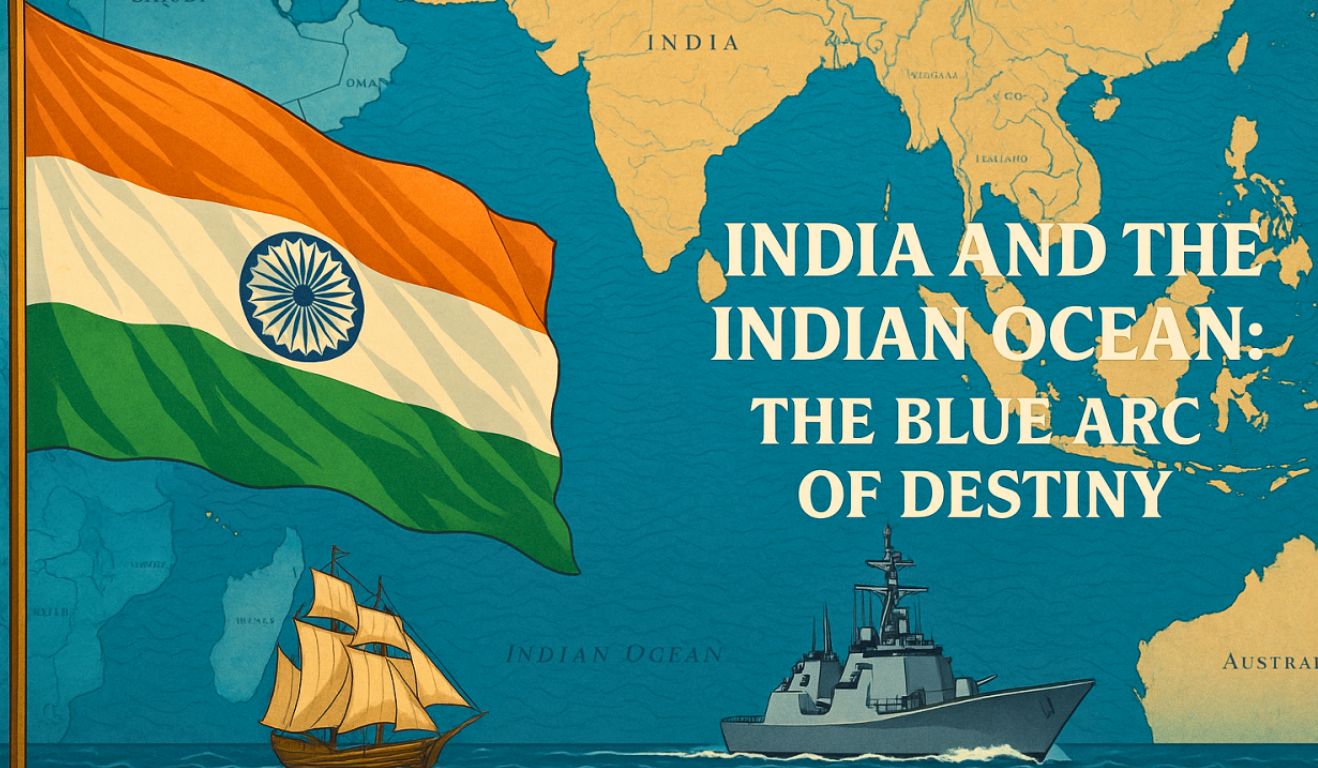
The Indian Ocean is not just a stretch of water—it is the curvature of India’s strategic identity. Shaped like an embracing arc from the eastern coast of Africa to the islands of Indonesia, it forms a luminous crescent that I call the Blue Arc of Destiny. Within this arc lies the pulse of the world’s commerce, energy, and security—the very heartbeat of the global economy.
India stands at the center of this arc, its peninsular reach projecting deep into the sea, commanding natural visibility across the major east–west shipping routes. From the Gulf of Aden to the Straits of Malacca, more than two-thirds of the world’s oil and half of global container traffic flow through these waters. Here, the convergence of sea lanes of communication defines not only trade but the fate of nations.
For India, this geography is not a gift—it is a responsibility. A responsibility to safeguard the routes that carry food, fuel, and freedom. A responsibility to maintain the balance between development and deterrence. The Blue Arc is not about possession but about presence. It calls upon India to evolve from a continental mindset to an oceanic consciousness.
The concept of the Blue Arc of Destiny thus represents more than strategy—it is India’s maritime philosophy. It blends geography with governance, security with sustainability, and ambition with accountability. To protect these waters is not merely to secure India’s interests, but to secure the rhythm of global life itself.
“The sea does not ask who owns it; it watches who understands it.”
The Contested Ocean – Challenges, Conflicts, and India’s Strategic Resolve
“Beneath every calm sea lies a storm unspoken.”
The Indian Ocean today is not merely a crossroads of trade; it is a chessboard of competing ambitions. Powers old and new converge upon its waves, seeking footholds on its islands and influence in its ports. What was once a tranquil highway of commerce has become the front-line of a silent struggle for dominance.
China’s expansion through its so-called String of Pearls—from Gwadar in Pakistan to Hambantota in Sri Lanka, from Djibouti in Africa to Ream in Cambodia—marks a determined bid to encircle India’s maritime sphere. Western alliances such as AUKUS and the QUAD reimagine their presence to ensure stability, yet the overlapping of interests has also intensified the complexity of competition. The Indian Ocean, once a realm of open waters, now faces the shadows of militarization.
India’s stakes are immense. Over 90% of its trade by volume and nearly all its energy imports move by sea. The security of sea lanes of communication (SLOCs) through choke points like Hormuz and Malacca is not a strategic preference—it is a national lifeline. Every disruption ripples into food prices, fuel supply, and industrial growth. Protecting these arteries is therefore not optional—it is existential.
But the challenges go beyond rival powers. Political instability in littoral nations—whether economic fragility in Sri Lanka, ideological drift in the Maldives, or military unpredictability in Myanmar—creates vacuums where external influence thrives. Piracy in the Red Sea, climate threats to island nations, and the exploitation of marine resources compound the turbulence.
India’s strategic resolve, therefore, must combine realism with restraint. To maintain balance amid global undercurrents, India must defend without domination and engage without entrapment. It must continue to build deterrence quietly, through partnerships, presence, and preparedness.
“The waves carry whispers of ambition—each nation seeks depth, few seek balance. For India, balance itself is the new courage.”
India’s Maritime Reawakening
“When a nation rediscovers its sea, it rediscovers its destiny.”
After centuries of neglect, India’s maritime consciousness is stirring once again. The waves that once carried saints and sailors are now reflecting radar echoes of renewal. The reawakening began not with a single policy but with a shift in perception — from seeing the sea as a frontier to understanding it as a force of future.
Over the past two decades, India has methodically begun to strengthen its naval presence and maritime infrastructure. The modernization of the Indian Navy — through indigenous shipbuilding programs, new aircraft carriers, nuclear submarines, and next-generation surveillance systems — has turned intent into action. The INS Vikrant, built entirely in India, stands as a floating symbol of self-reliance, marking a generational shift from dependence to design.
India’s strategic outposts from the Andaman & Nicobar Command to the coastal radar chains across the Indian Ocean littoral extend a vigilant arm across key sea lanes. The Navy’s operational footprint now spans from the western Indian Ocean to the South China Sea, demonstrating reach without overreach.
Diplomatically, India’s maritime reawakening is matched by a robust framework of partnerships. Through QUAD, it collaborates with like-minded democracies; with France, it builds bridges across the western Indian Ocean; through IORA, it leads regional development and disaster response initiatives. The doctrine of SAGAR — Security and Growth for All in the Region captures India’s belief that power and peace must sail together.
This resurgence is not an arms race; it is a reassertion of responsibility. India’s presence brings stability to volatile waters, humanitarian relief to crises, and reassurance to smaller nations. Each mission, from anti-piracy patrols to evacuation operations, carries both purpose and principle.
“India’s rise at sea will not be measured by how many ships it commands, but by how many shores it reassures.”
The New Maritime Doctrine – Power, Partnership, and Presence
“In an age of shifting tides, presence itself is power.”
India’s emerging maritime doctrine rests upon three anchors — Power, Partnership, and Presence. Each is essential, and none can sustain without the others. This triad transforms India’s naval outlook from a defensive posture to a dynamic policy of engagement and influence.
Power is not just the strength of fleets or the number of ships afloat. It lies in capability and credibility in the ability to deter threats, respond to crises, and project assurance. India’s modernized navy, backed by indigenous shipbuilding, missile systems, and cyber–space integration, represents not aggression but awareness a readiness that commands respect.
Partnership is the second anchor. The ocean, by nature, refuses isolation. India’s doctrine emphasizes cooperative security over competitive dominance. Through QUAD, IORA, ASEAN dialogues, and bilateral exercises with powers such as France, Japan, the U.S., and Australia, India builds an ecosystem of trust and interoperability. This is not alignment; it is alignment with purpose.
Presence is the final and perhaps most profound pillar. From anti-piracy patrols in the Gulf of Aden to humanitarian relief in the Maldives and Mozambique, India’s footprint across the ocean reflects not occupation but obligation. Presence signals reliability the quiet language of assurance in maritime affairs.
India’s new doctrine, therefore, merges pragmatism with principle. It recognizes that deterrence and diplomacy must sail together, that might must always anchor on morality, and that influence is earned not through intimidation but through integrity.
“The ocean respects no flags — only the presence of those who protect its peace.”
Blue Economy and Blue Dharma
“Prosperity from the sea must never come at the cost of its soul.”
If the Indian Ocean is the stage of our strategy, it is also the sanctuary of our sustainability. The future will not belong to those who only command the waves, but to those who understand their rhythm. Here lies the essence of India’s maritime philosophy the convergence of Blue Economy and Blue Dharma.
The Blue Economy represents the immense promise of the ocean renewable energy, fisheries, minerals, biotechnology, shipping, and tourism — all vital to India’s economic expansion. With over 7,500 kilometers of coastline and two million square kilometers of Exclusive Economic Zone, India’s maritime wealth is both vast and varied. Harnessing it responsibly could transform millions of lives, generate employment, and contribute enormously to GDP growth.
Yet, Blue Dharma reminds us that development without duty desecrates the very ocean that sustains it. The seas are not assets to be exhausted; they are trusts to be tended. Our scriptures saw water as sacred, and our ancestors treated its abundance with humility. The same spirit must guide our modern science and policy.
Sustainable fishing, coastal zone management, clean shipping, and marine biodiversity protection are not optional endeavours they are national dharma. Technology, when aligned with ethics, becomes an act of service. As India leads efforts on climate adaptation, island resilience, and ocean governance, it must demonstrate that growth and guardianship can coexist.
“We are not masters of the ocean; we are its trustees and stewardship is the truest form of strength.”
The Indian Ocean as Destiny, Not Geography
“Destiny is geography made conscious.”
The Indian Ocean is more than a body of water it is a continuum of India’s spirit. From the harbours of the Indus Valley to the shipyards of modern Visakhapatnam, the sea has remained both witness and participant in India’s civilizational journey. Empires have come and gone, yet the ocean’s tide continues to echo with India’s enduring rhythm.
History reveals that India’s identity was once defined by its maritime confidence. The Cholas sailed to Southeast Asia with fleets that carried both commerce and culture. The Kalingas traded with the world long before global trade had a name. These were not mere voyages of wealth they were journeys of will and wisdom. Today, as India rises again, the same maritime instinct returns, now armed with science, sovereignty, and strategic sense.
This ocean is not India’s periphery; it is her pulse. The sea lines that pass through these waters are not just arteries of trade they are the channels of trust, freedom, and global interdependence. To secure them is to secure the future of both India and the world.
In the 21st century, India’s destiny will be defined by its maritime vision by how it balances power with principle, assertion with assurance. The Indian Ocean is not merely the stage of competition; it is the crucible of cooperation. Whoever safeguards its openness and order will command not only routes but respect.
“The destiny of India will not be written on land or in air it will be etched upon the waves of the Indian Ocean.”
Epilogue: The Call of the Blue Horizon
“The sea calls not for conquest, but for courage.”
As the dawn breaks over India’s eastern waters and the last light fades into the Arabian horizon, a truth emerges from the waves the ocean does not belong to those who claim it, but to those who care for it. India’s tryst with the Indian Ocean is not an episode of ambition; it is a renewal of purpose.
The Blue Arc of Destiny is more than a maritime metaphor it is a national awakening. It calls upon India to see the sea not as a divide but as a destiny, not as a boundary but as a bond. The ocean links India’s past with its promise, carrying both memory and mission.
To navigate these waters is to understand that leadership at sea is not about ruling the waves but about reading their will. The ocean respects humility more than hubris, and the nations that endure are those that listen to its rhythm.
As India sails into the decades ahead, its compass must point toward inclusion, innovation, and integrity. The waves will test resolve, the depths will demand wisdom but the horizon, always expanding, shall reward perseverance.
“The horizon is not the end of sight it is the beginning of vision. And for India, that vision begins with the sea.”
And so, may Varuna guard our courage, and Neptune bless our course. May India sail not merely to conquer the seas, but to serve the harmony of the world. For the ocean is not ours to rule it is ours to revere.”
Postscript: The Next Horizon
As India sails confidently upon the Blue Arc of Destiny, one question now gathers on the horizon does the ocean that bears our name not deserve a singular nerve center, an Indian Ocean Command to guide its stewardship and strength?
That reflection shall form the heart of our next column a dialogue between vision and necessity, strategy and soul. For beyond geography, leadership too must find its tide.
Therefore, kindly await my next column to follow --- “India and the Indian Ocean Command – From Maritime Vision to Maritime Authority” (Building the Nerve Center of the Blue Arc)
Contributed by Commander Prasad YVV, IN-Sr. Veteran
Founder and Managing Director of Prasad Consulting Hyd (India)