- Home
- msme
- Budget 2026: Defence and Aerospace Industry Seeks Scale Capital, MSME Push and Export Enablement
Budget 2026: Defence and Aerospace Industry Seeks Scale Capital, MSME Push and Export Enablement
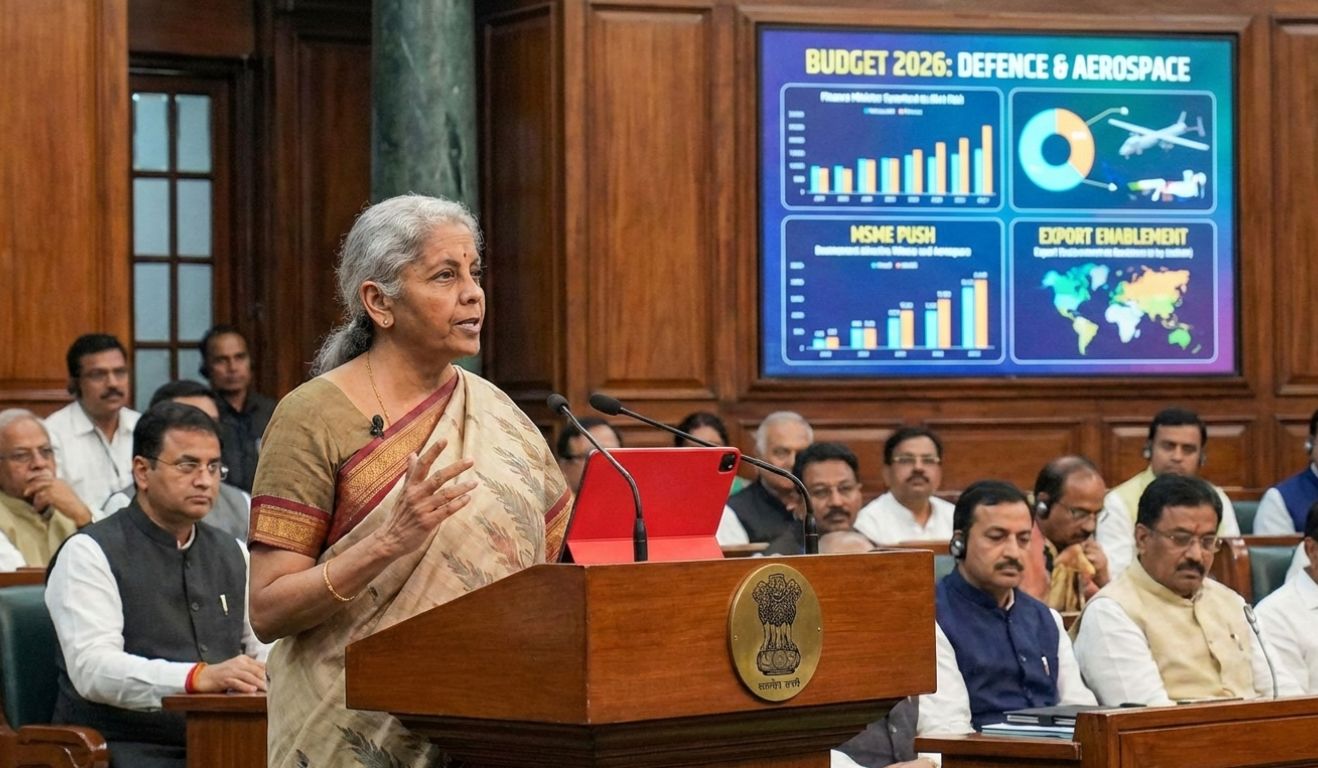
As India’s defence and aerospace manufacturing ecosystem enters a decisive scale-up phase, industry leaders are calling on the Union Budget 2026–27 to prioritise execution certainty, capital support, MSME incentives and export readiness to sustain momentum built under flagship programmes such as Make in India and Atmanirbhar Bharat.
Executives across defence manufacturing, aerospace components and drone technology say the next phase of growth will depend less on policy intent and more on predictable execution, long-term visibility and financial support for scaling production.
Need for Capital and Procurement Clarity
Ankur Shah, Managing Director of Krishna Defence and Allied Industries, said domestic capabilities have been created, but sharper implementation is now essential.
“Higher capital allocation, faster procurement timelines and clearer long-term order visibility are critical to unlock private sector investment, especially in precision manufacturing and R&D-led innovation,” Shah said, adding that execution delays continue to discourage deeper participation by private players.
MSMEs Seek Targeted Support
MSMEs are emerging as a backbone of India’s defence supply chain, particularly in components, plastics, tooling and drone manufacturing.
Hiren Shah, Managing Director of Jyoti Global Plast, said targeted incentives could help smaller firms move up the value chain.
“Rationalised taxation, focused capex incentives and R&D enablement will allow MSMEs to scale indigenous technologies and reduce reliance on imports,” he said.
Drones Seen as Near-Term Growth Engine
The drone sector is being viewed as one of the fastest routes to commercial and defence-led growth.
Dr Preet Sandhu, Founder and Managing Director of AVPL International, said Budget 2026 should strengthen the Drone Shakti initiative with production-linked incentives.
“Shared testing and certification infrastructure, along with skill-linked training facilities, can shift the ecosystem from pilot projects to large-scale deployment,” she said, noting that faster certification would significantly accelerate innovation.
Export Readiness a Key Bottleneck
While global demand for Indian defence exports is rising, manufacturers say scaling for international markets remains capital-intensive.
Vamsi Vikas, Founder and Managing Director of Raghu Vamsi Aerospace Group, highlighted compliance costs as a major hurdle.
“Upfront investment in certifications, documentation, quality systems and after-sales infrastructure is unavoidable for exports. The Budget should support scale and global competitiveness rather than micromanagement,” he said.
Call for Long-Term Stability
Industry leaders also emphasised the need for predictable capital cycles and policy stability, noting that defence manufacturing requires long gestation periods, sustained workforce development and consistent quality standards.
They argue that Budget measures reinforcing indigenisation goals while reducing execution friction could help India evolve from a domestic supplier into a credible global defence manufacturing and export hub.
As Budget 2026 approaches, the sector’s message is clear: India has built the foundation; the next step is scale, speed and global integration.