- Home
- article
- AI and the Future of Indian Defence Forces (2026–2036): A Questioning Vision on Strategy, Systems, Sovereignty & Superiority in the AI Era
AI and the Future of Indian Defence Forces (2026–2036): A Questioning Vision on Strategy, Systems, Sovereignty & Superiority in the AI Era
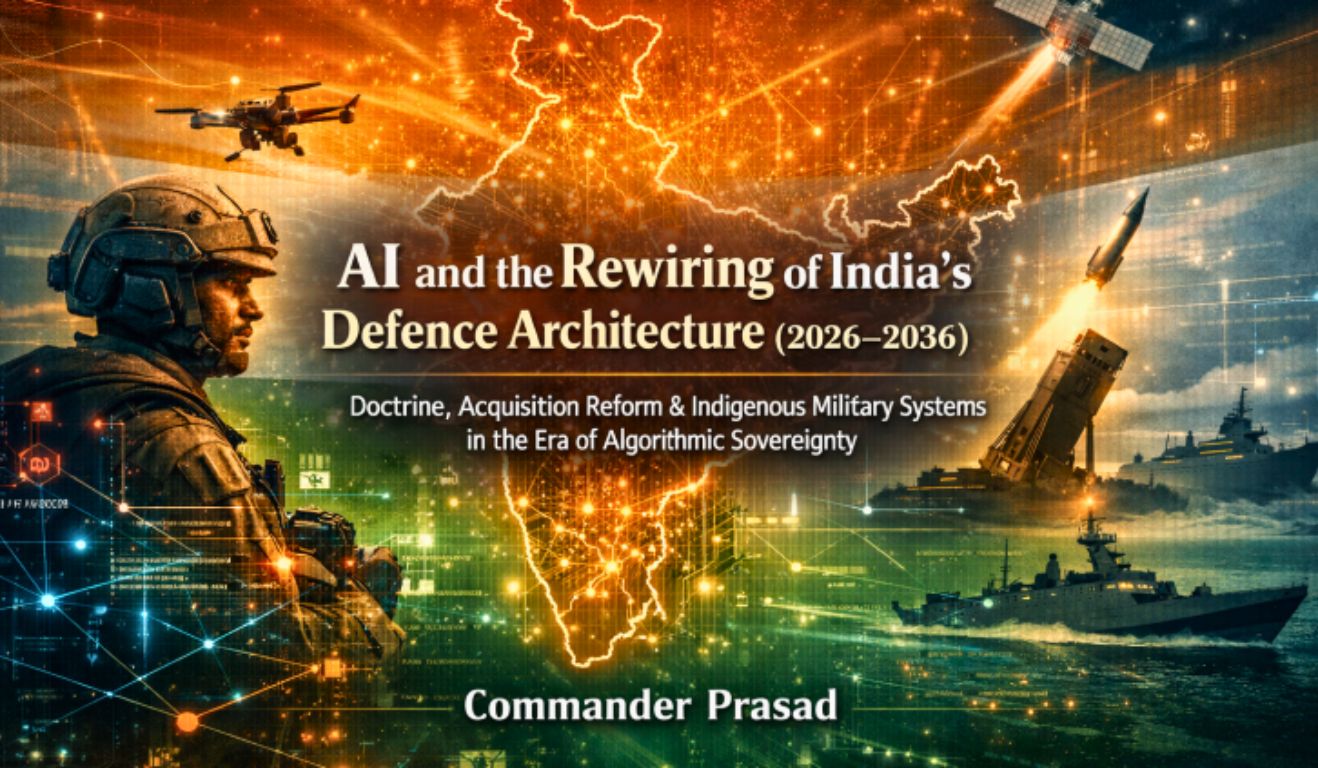
Quadrilateral Series – Paper II - Title : "AI and the Rewiring of India’s Defence Architecture (2026–2036) : Doctrine, Acquisition Reform & Indigenous Military Systems in the Era of Algorithmic Sovereignty."
“Future wars will not be won by those who possess the most machines, but by those who govern intelligence with architectural discipline.”
This paper argues that Artificial Intelligence is not merely a force enhancer; it is an institutional stress test. It exposes the rigidity of legacy procurement cycles, the fragility of fragmented data systems, and the limitations of platform-centric doctrine.
AI demands not enthusiasm, but engineering not acquisition, but architecture. The nations that understand this distinction will define the strategic geometry of the next decade.
If Paper I examined AI at the operational and battlefield layer, Paper II moves deeper into the institutional core. This paper II examines how AI compels structural transformation across : (i) Military Doctrine; (ii) Acquisition and Procurement Philosophy; (iii) Indigenous Defence Manufacturing; (iv) Data Governance Architecture; (v) Joint Theater Integration; (vi) Algorithmic Sovereignty
In the algorithmic era, military strength will be measured by coherence, not inventory. AI compresses decision cycles and redefines sovereignty at the level of code and data. Unless doctrine becomes software-aware, acquisition becomes lifecycle-adaptive and indigenous systems remain sovereign at the algorithmic core, technological progress will remain fragmented. Strategic advantage will belong to institutions that integrate intelligence structurally, not symbolically.
The central argument is clear AI superiority will not emerge from technology acquisition alone. It will emerge from architectural discipline.
Between 2026 and 2036, India faces a decisive institutional decade. Procurement cycles must evolve. Doctrine must become software-aware. Industry must develop sovereign algorithmic cores. Leadership must embrace cognitive transition.
The question is not whether AI will enter the Indian defence ecosystem. The question is whether our institutions will evolve fast enough to govern it coherently. “Architecture, not acquisition, will determine strategic destiny.”
I invite policymakers, defence professionals, industry leaders, research institutions and strategic thinkers to engage with this second paper in the series.
The algorithmic era demands structural clarity.