- Home
- MSME
- PM Modi Inaugurates SEMICON India 2025, Showcasing India’s Ambitions as Global Semiconductor Powerhouse
PM Modi Inaugurates SEMICON India 2025, Showcasing India’s Ambitions as Global Semiconductor Powerhouse
Updated :9/11/2025 /Shathamanyu /
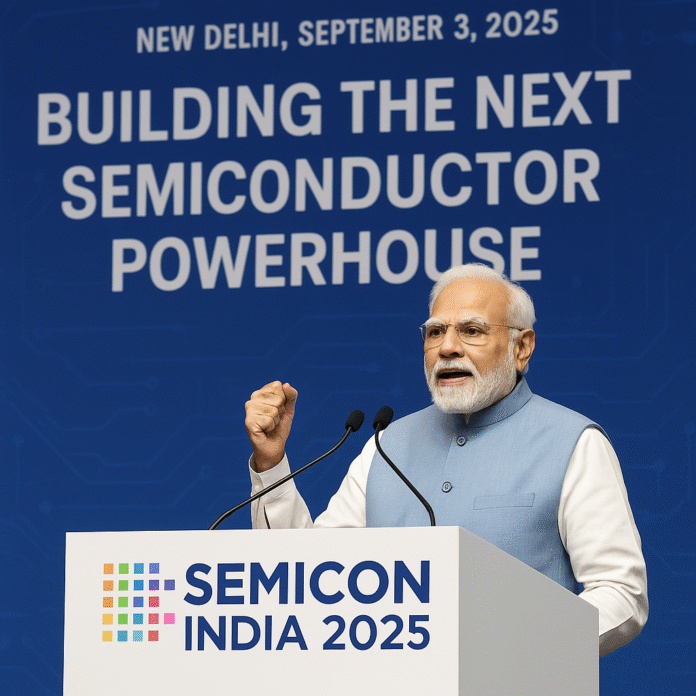
New Delhi, September 3, 2025 – Prime Minister Narendra Modi yesterday inaugurated SEMICON India 2025, a landmark event
underscoring India’s rapid strides toward becoming a key player in the global semiconductor ecosystem. The three-day conference,
held from September 2-4 at Yashobhoomi in New Delhi, is themed “Building the Next Semiconductor Powerhouse” and marks the fourth
edition of India’s premier semiconductor and electronics showcase. Organized by the India Semiconductor Mission (ISM) under the
Ministry of Electronics and Information Technology (MeitY) in collaboration with SEMI, the global semiconductor industry
association, the event drew over 350 exhibitors from 33 countries and is expected to attract more than 15,000 visitors.
In his inaugural address, PM Modi emphasized India’s growing confidence on the world stage, stating, “Today’s India inspires
confidence in the world… When the chips are down, you can bet on India.” He highlighted the nation’s progress in fostering
innovation and self-reliance in semiconductors, a sector critical for technologies like AI, electric vehicles, and defense
systems. The event features six country roundtables, four country pavilions, and participation from nine Indian states, focusing
on areas such as fabs, advanced packaging, smart manufacturing, AI, and supply chain management. Special pavilions include
workforce development and SEMI University programs, alongside sustainability initiatives and over 280 academic institutes
showcasing state-of-the-art design tools.
A major highlight was the presentation of India’s first indigenous semiconductor chip, the Vikram processor, to the Prime Minister
by Union IT Minister Ashwini Vaishnaw. This milestone follows the recent launch of CG-Semi’s OSAT pilot facility in Sanand,
Gujarat, on August 28, which produced the chip and represents a significant step in India’s manufacturing capabilities. The
government has committed nearly ₹65,000 crore under the ₹76,000 crore Production Linked Incentive (PLI) scheme, with 10 approved
projects across six states attracting investments of ₹1.60 lakh crore. Additionally, 23 chip design projects have been sanctioned
under the Design Linked Incentive (DLI) scheme to bolster startups and innovators, including advanced designs for defense,
aerospace, and energy sectors.
Vaishnaw, who earlier in May inaugurated two cutting-edge semiconductor design facilities in Noida and Bengaluru capable of
3-nanometer chip design, described the progress as “truly next-generation,” noting India’s evolution from 7nm and 5nm designs to
this advanced frontier. The event also facilitates cross-border collaborations, with global majors like Micron Technology, Applied
Materials, AMD, Foxconn, and Cadence participating, alongside representatives from Japan, the US, Singapore, Malaysia, and Korea.
STARTUPS AND MSMES POISED TO LEAD INDIA’S SEMICONDUCTOR CHARGE
India’s semiconductor goals are heavily reliant on its vibrant ecosystem of startups and Micro, Small, and Medium Enterprises
(MSMEs), which are increasingly driving innovation in chip design, fabrication, and testing. Under the DLI scheme, financial
incentives and infrastructure support are extended to domestic companies, enabling them to compete globally. Several startups have
emerged as frontrunners, leveraging government backing to address niche markets and contribute to self-reliance.
Key players include:
* Mindgrove Technologies: Specializing in high-performance System-on-Chips (SoCs), including India’s first commercial indigenous
microcontroller, Mindgrove is targeting IoT and automotive applications, positioning itself as a leader in affordable, secure
chip solutions.
* Signalchip: Focused on radio frequency (RF) transceivers and baseband chips for 4G/5G networks, this Bengaluru-based firm is
pivotal in enhancing India’s telecom infrastructure and reducing import dependence.
* Saankhya Labs: Known for wireless communication chips and satellite broadband solutions, Saankhya is advancing 5G and
defense-grade semiconductors, with recent acquisitions boosting its global reach.
* Vervesemi Microelectronics: Developing advanced ASICs for aerospace, EVs, and energy systems, Vervesemi is one of the
beneficiaries of the 23 DLI-sanctioned projects, emphasizing precision and reliability.
* Morphing Machines: Innovating in reconfigurable processors for adaptive computing, this startup is ideal for AI and edge
devices, helping India tap into emerging tech trends.
MSMEs, which form the backbone of India’s semiconductor mission, are shifting focus to reduce import reliance and integrate into
global supply chains. With over 50 such entities like Calligo Technologies (high-speed computing) and FermionIC Design (analog
IPs), these firms benefit from schemes providing up to 50% incentives on project costs. Their role is crucial in areas like
fabless design, where India already holds intellectual property strengths, potentially generating thousands of jobs and propelling
the sector toward a projected $110 billion valuation by 2030.
CHALLENGES IN INDIA’S CHIP MANUFACTURING JOURNEY
Despite the momentum, India faces formidable hurdles in scaling up semiconductor manufacturing. A primary challenge is the
underdeveloped supply chain, which lacks domestic sources for critical raw materials and equipment, leading to heavy reliance on
imports. Skilled workforce shortages persist, with a need for specialized talent in fabrication and advanced design—India produces
engineers but often lacks hands-on manufacturing expertise.
Infrastructure demands are another barrier: Semiconductor fabs require ultra-pure water (up to 10 million liters daily per plant),
stable power supply, and cleanrooms, but India grapples with water scarcity and inconsistent electricity in key regions. High
capital costs—often exceeding $5-10 billion per fab—coupled with technological gaps and global competition from established hubs
like Taiwan and South Korea, make entry challenging. Environmental concerns, including hazardous waste from chemical-intensive
processes, add regulatory pressures. Experts warn that without addressing these, India’s ambitions could falter, emphasizing the
need for sustained investments in R&D and ecosystem building.
GEOPOLITICAL ANGLE: STRATEGIC TIES FOR RAW MATERIAL SECURITY
India’s semiconductor push is deeply intertwined with geopolitics, particularly amid US-China trade tensions and efforts to
diversify global supply chains away from China, which dominates raw material production. By forging partnerships with key nations,
India aims to secure essential inputs like high-purity silicon (from Germany and the US), rare earth elements (from Australia and
Japan), photoresists and gases (from Japan and South Korea), and advanced tools (from the Netherlands and the US).
Strategic alliances under frameworks like the US-India Initiative on Critical and Emerging Technology (iCET) are enabling
technology transfers and joint ventures, reducing vulnerabilities to disruptions. Ties with Japan and Singapore provide access to
expertise in packaging and testing, while discussions with Taiwan—home to TSMC—could facilitate fabs and silicon wafer supplies,
though geopolitical sensitivities around China-Taiwan relations pose risks. Australia’s role in rare earths mining offers a buffer
against China’s 80% market control, aligning with QUAD (US, India, Japan, Australia) objectives for resilient supply chains.
These partnerships not only bolster raw material access but also enhance India’s foreign policy leverage, positioning it as a
neutral hub in a fragmented global landscape. However, US dominance in semiconductor IP and export controls could limit India’s
autonomy, requiring balanced diplomacy to avoid overdependence.
As SEMICON India 2025 unfolds, it signals India’s determination to transform from a design-centric player to a full-spectrum
semiconductor powerhouse, with startups, MSMEs, and international collaborations at the forefront. The event’s outcomes could
shape the nation’s tech future amid evolving global dynamics.
Recent news
Top Stories